

InteractiveWorld A Verifiable Human-Centric Environment for Building Better Interactive MLLM Assistants

People have long dreamed of an assistant that is always there: one that sees what they see, remembers what they forget, and guides them through what they have never done. Wearable AI is bringing that dream within reach.

Can today’s agents truly help people in the physical world?

InteractiveWorld

The first environment that realistically simulates a human and a wearable AI assistant interacting in the physical world: the assistant sees through the human’s eyes and talks, the human decides and acts, and the world responds.

Interactive Demo

Pick a request, then watch the glasses assistant guide a simulated person through a photorealistic home.

Glasses assistant Listening

You Choose a request
Your actions Waiting

    Actions will appear here once you ask for help.

    First-person view 00:00
    Choose a request to start
    Assistant You

    50+ Human Actions

    The human agent turns guidance into short commands that name only an action and its targets, such as [GRAB] <cup> or [PUTINSIDE] <mug> <dishwasher>. The simulator works out the motion and renders what the person sees.

    • Grab

      [GRAB] <olive oil>

    • Put

      [PUT] <pan> <burner>

    • Put Inside

      [PUTINSIDE] <mug> <dishwasher>

    • Open

      [OPEN] <fridge>

    • Pour

      [POUR] <tray> <olive oil>

    • Turn On

      [TURNON] <microwave>

    • Cut

      [CUT] <tomato> <knife>

    • Stir

      [STIR] <mug> <chopstick>

    • Wipe

      [WIPE] <sponge> <counter>

    • Use Computer

      [USECOMPUTER] <keyboard>

    Fully Autonomous Planning & Behavior

    The human in InteractiveWorld is an autonomous agent. It hears free-form advice, decides what to do from what it sees, and its body works out the rest: where to stand, how to get there around furniture and through doors, how to lean or squat, and how to grip each object.

    Finds Its Own Way

    [WALK] <washer>

    Finds a reachable place to stand by the target, plans a collision-aware A* route across rooms and walks it with continuous turns. A closed door on the way is opened, then the walk goes on.

    Chooses Where to Stand

    [GRAB] <apple> → [PUT] <apple> <counter>

    Samples standing spots around the target and checks reach, clearance and collisions. The closest valid one wins, so the human walks round the island to the apple, then over to the counter.

    Shapes Its Own Grip

    [GRAB] <apple> · <bottle> · <box> · <pan> · <cup> · <bag>

    The grasp follows each object's shape and parts: a pinch for small or flat things, a cylindrical wrap for tall ones, a round grip otherwise, and the palm on the bar for handles.

    InteractiveBench

    The first closed-loop benchmark for egocentric AI assistants, with 120 multi-turn tasks in six categories. In every task, each instruction shapes what the human does next, and success is read from the world’s final state.

    A Unified Evaluation Framework

    The model under test plays the assistant and sees only the human’s first-person view. A fixed MLLM plays the human and only follows its guidance. InteractiveWorld carries out every action, so the assistant’s words decide the outcome.

    Assistant Agentthe MLLM under test

    Sees only the first-person view and the dialogue

    silentspeakdone
    Human Agenta fixed MLLM following guidance

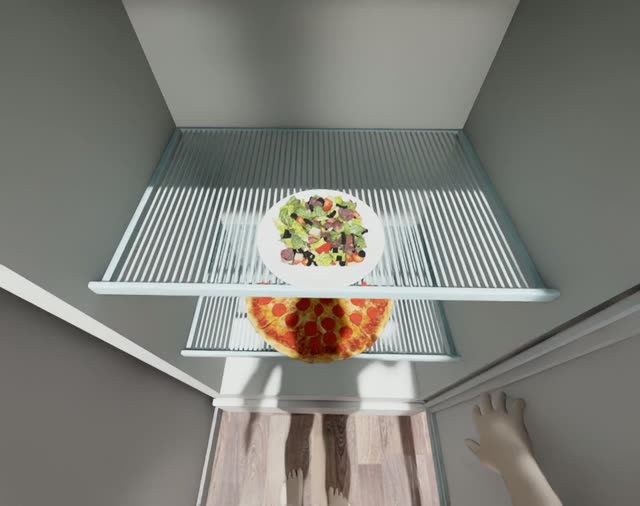
    1. [GRAB] <salad>
    2. [WALK] <table>
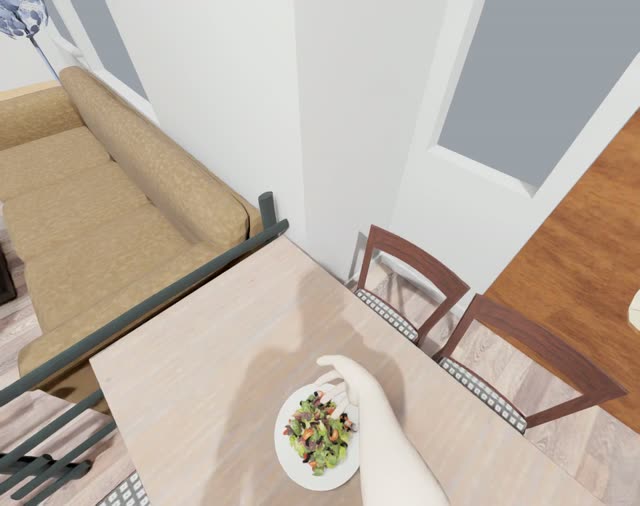
    3. [PUT] <salad> <table>

    Executable actions appear here

    InteractiveWorldexecutes actions, tracks object states
    First-person view: a salad on the fridge shelf First-person view: the salad being placed on the table State stState st+1

    Final State Check

    ✓Salad on the table

    ✓Cola not on the table

    Task success

    Guidance Question Action at Renders the next first-person view

    6 Task Categories

    120 human-reviewed tasks, 20 per category, each ending in object states the simulator can check. Every clip below is a real InteractiveBench episode played by the oracle assistant, sped up, with its dialogue and actions overlaid.

    Guidance

    20 tasks

    Guides the user step by step, based on their progress.

    ExampleGriddled Tomato. A first-time cook follows a recipe card. The assistant hands out the next step only once the last one is done.

    GUIDE-14004

    I haven't made this dish before. Guide me one step at a time.

    Planning

    20 tasks

    Plans steps within time and resource limits, and replans on the fly.

    ExampleCooking for Four Guests. Four allergies, nine menu cards, one oven and one stove, 30 minutes: the assistant picks the safe maximum and schedules it.

    ORCHESTRATE-99902

    No dairy, shellfish, gluten or sesame. Most safe dishes in 30 min?

    Accessibility

    20 tasks

    Describes the scene so blind or low-vision users can act on their own.

    ExampleKitchen Cleanup. The human agent gets no images. The assistant reads the cleanup guide and talks the user through glass, food and dishes.

    The human sees nothing NARRATE-87016

    What's on these surfaces? Guide me through the cleanup, one item at a time.

    Decision

    20 tasks

    Makes everyday decisions from what it has seen plus world knowledge.

    ExampleSupplier Comparison. An order for 40 filters is read in one room, two quotes with different pack sizes in another. The cheaper offer for the full order wins.

    ASK-81019

    Watching the requisition being read.

    Prevention

    20 tasks

    Warns before a mistake happens, while avoiding needless interruptions.

    ExampleLeaving Home. The fridge and the window were opened earlier. The assistant stays quiet, then stops the user at the exit.

    WATCH-47003

    Watching quietly. Nothing needs saying yet.

    Finding

    20 tasks

    Finds missing objects by remembering where they went.

    ExampleMisplaced Cola. The user leaves a red cola on a dining-room table, puts water in the fridge and takes a call, then asks where the cola went.

    FIND-87004

    Watching where the red cola goes.

    Evaluation Results

    Twelve frontier MLLMs take turns in the assistant’s seat, with Gemini 3.1 Pro as the same human agent for all of them. A task passes only if every goal state holds at the end; MCR also gives credit for partial progress.

    Leaderboard

    Pass rate (%) over all 120 tasks

    Click a category or metric to re-rank the models

    Task category
    Metric
    Pass: share of tasks with every objective met. MCR: mean fraction of objectives met per task. The same human agent scores 100% with an oracle assistant.

    Nine Capabilities, Scored Separately

    Share of passed capability checks (%). Color shows distance from the 12-model mean of each capability.

    Models are ordered by overall task pass rate. Bold marks the best model per capability.

    Five Key Findings

    1

    Closed-Loop Assistance Is Far from Solved.

    Even the strongest model helps the human finish fewer than half of the tasks (41.7%), and every other model stays at or below 33.3%. With an oracle assistant, the same human passes all of them.

    2

    One-Shot Decisions Work. Sustaining the Loop Does Not.

    The best models reach 85% on Decision, which often hinges on one scene judgment, but only 20% on Guidance and 25% on Planning, which demand continuous tracking, error spotting and replanning. Success also drops quickly as tasks get longer.

    3

    Most Failures Start with Perception and Memory.

    Misreading the scene or losing track of changes causes 70.4% to 85.7% of first errors. In a closed loop, a single misperception or forgotten state cascades into every instruction that follows.

    4

    Communication Is Critical.

    GLM 5.3 Flash and Claude Fable 5.1 have almost the same average capability score, yet GLM scores far lower on communication and completes 11.7 points fewer tasks. Success is bounded by the weakest link in the chain, not by the average.

    5

    Assistants Waste the Human’s Effort.

    Even on tasks they pass, models lead the human through many unnecessary actions: 2.35× to 3.66× the oracle’s steps on Guidance, and up to 6.75× on Accessibility. Efficiency depends on the task more than on the model.

    InteractiveWorld turns “does this assistant actually help?” into a question with a verifiable answer. Its state-based rewards also open the door to training assistants that truly help people.

    Citation

    @misc{wang2026interactiveworld,
      title         = {InteractiveWorld: A Verifiable Human-Centric Environment for Building Better Interactive MLLM Assistants},
      author        = {Wang, Qinsi and Wen, Wei and Zhou, Chong and Suri, Saksham and Liu, Zechun and Wu, Lemeng and
                       Li, Hai Helen and Chen, Yiran and Krishnamoorthi, Raghuraman and Qian, Qi},
      year          = {2026},
      eprint        = {2610.33966},
      archivePrefix = {arXiv},
      url           = {https://arxiv.org/abs/2610.33966}
    }